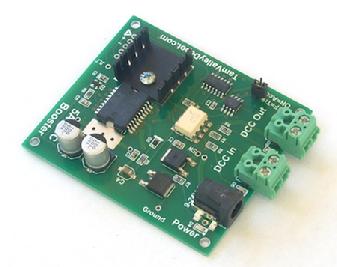
The simplest and quickest way to get servos up and running on your layout. Features an integrated controller/programmer/DCC decoder/power supply and servo driver in a tiny 1.25" x 1.25" board. Comes with a servo and a servo extension cord - simply plug in the servo and connect the unit to your DCC power bus and the wiring is finished. The Controller mounts behind your fascia through holes drilled using the drilling template. The controller doubles as a programmer letting you precisely set the turnout endpoints and to set the DCC address. The unit can be used without the DCC option on DC layouts by using an AC or DC power supply or you can also use it with DCC alone if you wish.
It also possible to use servos to animate semaphores, crossing gates and other items on your layout.
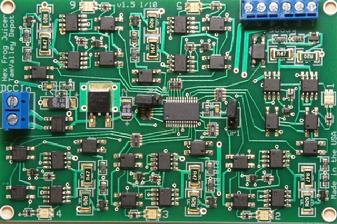
Are you avoiding wiring your frogs because it is too confusing? Do you have a frog that you find yourself pushing your trains through with the 0-5-0? Then this is the device for you - a circuit for automatically switching DCC power to 6 frogs for turnouts and/or crossovers that requires a single wire to the frog. Consists of 6 separate circuits for controlling up to 6 frogs with DCC power. If the polarity is wrong, the circuit automatically and nearly instantaneously switches the polarity. Very simple to install - connect it to your track bus and then connect 6 wires to 6 frogs, run trains.
Use to control four turnouts using R/C style servos. Servos are easily mounted under the turnout and provide a reliable and inexpensive method to switch points. You can move the points by DCC commands from your throttle, or use buttons on the fascia. LEDs can be hooked up to indicate the direction of throw. It also possible to use servos to animate semaphores, crossing gates, wigwags and other items on your layout.
Use to control two servos to 3 positions each turnouts using for semaphores and 3-way stub switches and any other application where 3 positions are needed. Servos are easily mounted under the turnout and provide a reliable and inexpensive method to switch points. You can move the points by DCC commands from your throttle, use logic-low signaling systems, or use buttons on the fascia. LEDs can be hooked up to indicate the direction of throw.
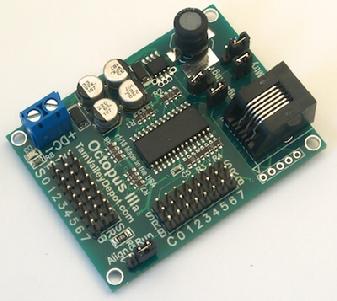
The Octopus can drive up to 8 servos at once making it an inexpensive way to add servos to your layout to drive turnouts or other devices. It uses toggles to control the turnouts or it can be connected to any open collector logic circuit.
The Octopus does not have DCC capability of indicator LEDS. If you don't want DCC then this is the cheapest per switch option.